Press Statement
FOR IMMEDIATE RELEASE
ABUJA — HipCity Innovation Centre welcomes the Federal Capital Territory Advance Rent Regulation and Tenants’ Protection Bill, 2026, now before the House of Representatives. The Bill is sponsored by Hon. Prof. Paul Nnamchi (Enugu East/Isuzo) and co-sponsored by Hon. Ahmed Yusuf Doro.
We have studied the Bill against our own policy brief, Rent and Tenancy Reform in Abuja (July 2026), which drew on consultations held on 16, 18 and 23 June 2026 with tenants, professional bodies, civil society organizations and government agencies. Our position is simple: we support the substance of the Bill, but we have serious concerns about its timing and about the creation of a new Authority to enforce it.
What the Bill gets right
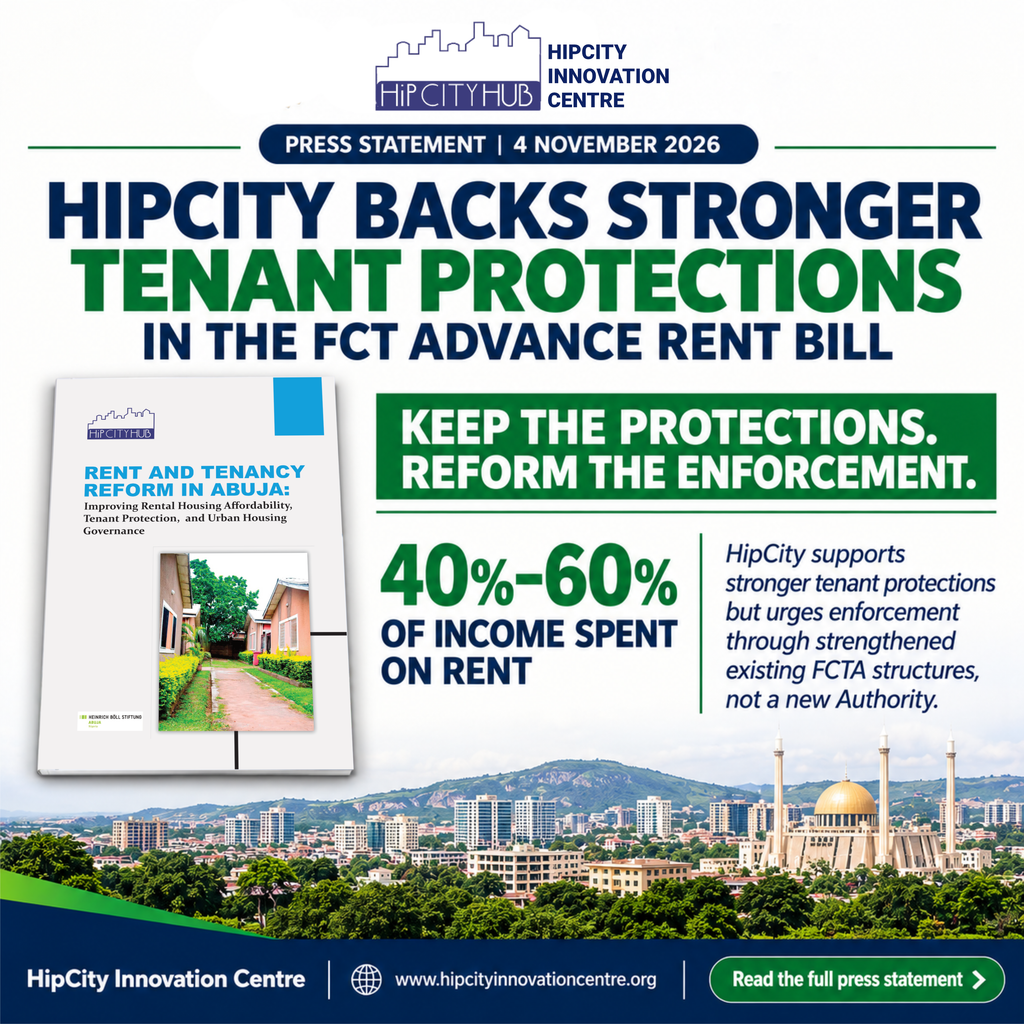
Several provisions answer problems our policy brief documented. Our brief found households spending 40% to 60% of income on rent against a 30% affordability benchmark, with advance rent demands of up to two years.
-A 12-month cap with teeth (s.4). The Bill bars compulsory advance rent beyond twelve months and closes the usual loopholes: intermediaries, “service charges”, artificial renewals and side agreements. Voluntary longer payment is allowed only if the tenant offers it, it is in writing, and the burden of proof sits on the person who collected the money.
-Written agreements and receipts (s.5). Every fee must be disclosed before signing and every payment receipted. This matches our call for standard tenancy agreements and payment transparency.
-Protection from retaliation and self-help eviction (ss.6, 18). Tenants who complain or refuse an unlawful demand cannot be punished, and landlords cannot cut services, change locks or remove property.
-Practical remedies (ss.7, 11, 20). Refund orders within thirty days, mediation, complaint offices reaching the satellite towns, and no fee for lodging a complaint speak directly to our finding that justice is slow, costly and out of reach.
-Balance and due process (ss.12, 15, 19). The Bill protects landlords’ right to lawful rent and recovery of possession, and allows appeal to the FCT High Court. Reform that tenants and landlords both see as fair is more likely to hold.
-Fair start-up (s.22(5)). Guidance and a public awareness programme must precede full enforcement.
Our concerns: timing and a new Authority
Relief would arrive late. Most remedies in the Bill, including complaints, compliance notices and refund orders, run through the proposed Authority. Before it can act, the Bill must pass both chambers, receive assent, and be given a commencement date by presidential order. The Minister then has three months to begin appointing the Board and Director-General, and the Authority has six months to become operational (s.22). The Chairperson, six Board members and the Director-General all require presidential appointment and Senate confirmation (ss.9, 10). Tenants are under pressure today, and this route leaves them waiting well beyond a year for the institution on which enforcement depends.
It adds to the cost of governance. The Authority would be a new body corporate with a Board, a Director-General, its own staff, premises, audits, annual reports, and complaint offices across the FCT including the satellite towns. It would be funded mainly by National Assembly appropriations (s.20). That is a permanent new cost, at a time when citizens expect government to become leaner, not larger.
It duplicates what exists and may deepen coordination gaps. The FCTA Legal Secretariat, the Department of Mass Housing (FCDA), the Area Council Services Secretariat, the FCCPC, the Legal Aid Council and the National Orientation Agency already hold mandates touching tenancy, consumer protection, mediation and public education. Our brief found that coordination among these bodies is very limited. A new authority adds one more institution to that crowded field without fixing the underlying problem, and risks overlapping jurisdiction.
A faster route exists. Our brief showed that the core reforms can be carried out administratively through the FCTA, without extensive legislative processes, with rent-payment regulation and dispute resolution achievable in about six months.
Our proposal: expand existing FCTA structures
We urge the House to keep the Bill’s protections and change who enforces them:
1.Keep the substance. Retain the 12-month cap, disclosure and receipt rules, anti-retaliation and unlawful-eviction provisions, refund orders, and the penalties in Parts II, IV and V.
2.Replace the new Authority with an expanded FCTA Secretariat. Vest the Authority’s functions in the FCTA, through its Legal Secretariat or any other department expanded into a dedicated Rent Regulation and Tenants’ Protection Department, with a clear budget line and staff largely redeployed from existing offices.
3.Assign supporting roles to bodies that already exist. The FCDA Department of Mass Housing registers and licenses agents; Area Council legal aid offices host complaint desks in the satellite towns; the FCCPC handles consumer-protection enforcement; the Legal Aid Council, the FCT Bar and the Institute of Chartered Mediators and Conciliators supply mediation capacity; the FCT National Orientation Agency leads tenant and landlord education.
4.Replace the Board with an advisory council. A Tenancy Advisory Council of tenant, landlord and estate surveyor representatives, meeting periodically without a salaried secretariat, would preserve the balance the Bill intends at a fraction of the cost.
5.Start now. The FCTA can begin issuing administrative tenancy guidelines and regulating rent-payment practices while the Bill is processed, so tenants do not wait for an institution to be built.
Call to action
We call on the House of Representatives to advance the Bill’s tenant protections expeditiously within the limited legislative tenure of the 10th assembly, amend Part III so that enforcement sits within the FCTA, and hold a public hearing that gives tenants, landlords, estate professionals and civil society a chance to be heard before the Bill goes further. We call on the FCTA to begin the administrative reforms immediately. Rent reform should lower the burden on residents quickly, not add another layer of bureaucracy.
Our call to the public
We call on tenants, landlords, estate agents, professional associations, community leaders, civil society groups and the media to read the Bill, discuss it openly, take part in the public hearing and give it the necessary backing and publicity.
A fair law protects the tenant from exploitation and the honest landlord from unfair competition. It gives the city a shared rulebook, and that is in everyone’s interest.
HipCity Innovation Centre stands ready to work with the sponsors, the relevant committees and any panel the House sets up, in whatever capacity they find useful. We can offer research, data, community mobilisation and public education, so that this Bill becomes an Act that people can live by. https://hipcityinnovationcentre.org/rent-and-tenancy-reform-in-abuja-improving-rental-housing-affordability-tenant-protection-and-urban-housing/
Issued by HipCity Innovation Centre
enquiries:
info@hipcityinnovationcentre.org,
info.hipcityhub@gmail.com | www.hipcityinnovationcentre.org | 08039906111
About HipCity: HipCity Innovation Centre is a registered research, development and advocacy nonprofit working on participatory governance, social inclusion and sustainable urban development in Nigeria.